April 24 & 25
Teaching in Mugu
For the past 2 days the team has been very busy in a room at Gamghadi teaching hospital. Joining us are 18 ANMs (Auxillary Nurse-Midwives), a few who are SBA (Skilled Birth Attendant) trained but most who are not.
We spent the first morning teaching about giving good care in labour, normal delivery and different positions for labour and birth, active management of the 3rd stage with delayed cord clamping. Many of the birth positions were new, as was delayed cord clamping for many. They were enthusiastic about the hands on learning. I got to be a living mannequin all day so I had many many babies! As my midwifery colleagues know even though I am a G0P0, I make a pretty convincing labouring woman. :) The rest of the day Nani worked with them through labour management and use of the partograph and a session on the 4 recommended antenatal visits. After all that was finished Nani and Cathy as a team, and Jill and Pema as a team were able to interview 6 of the ANMs for our research project.


On day 2 we reviewed the key pieces for birth planning preparedness, Helping Babies Breathe (WHO NRP), postnatal care, 8 danger signs of the newborn and care for a septic baby, management for postpartum hemorrhage and respectful maternity care. We had hands on practice today as well and had stations at the end to practice skills from the 2 days. Most people who participated seemed very interested in the training. Many were taking notes during the presentations and all were eager to do the skills practice. I enjoyed doing it. Their feedback was that they appreciated most learning the different positions in labour and delivery, somersault nuchal cord delivery and all the demonstrations and hands on learning experiences. In the future they would like more training on degrees of prolapsed uterus and treatment options as it is a major problem for women here. Afterwards we were able to do 7 more interviews.

My mood vacillates. Mostly I am so excited and grateful for this opportunity. And sometimes I am overcome with sadness over how unjust it is, this life. Some of us with so much ability to move and chose and do and be. And so many others who choices are very very limited. The mixture of teaching and research I really appreciate about our work here. We hope that the research will be useful to the government in reaching the women and babies who desperately need more resources and that it will be the voices of the women who are able to tell the government through the research project what their needs are. And I loved teaching. I have skills, they save lives and I am able to share them. It is incredible. We have shared so many good things, all of the team, with the women. If they take even just a small amount with them I feel like it could make a difference in their practice.
After the training the project provided the required per diems, as set by the government for organizations offering training to cover the cost of travel and stay while the women are away from their communities. The longer the walk, the larger the stipend. However, the stipend is very large. From a health systems perspective I find this perplexing. I think providing a stipend to cover food and travel costs seems very reasonable. Likely none the women would be able to afford to come otherwise as they are very poor, and very remote. However, the amount that we were required to pay seemed too high for a stipend - for some it was half to one months wages.
Part of what we were hearing when the ANMs were role playing with pregnant mothers is them trying to coerce them into coming to the birth centre for their safety or bribing them, because the government pays them if they come to 4 antenatal visits and for 'travel' if they birth in the centre. They also pay the FCHVs (Female Community Health Volunteers) a stipend when they get women to come. Coercion and bribery are not part of midwifery care. We emphasized in our training that the most important thing is to be kind to the mothers. Let them know you are there to help them and bring them to you with your kindness and care and skill. But today I felt a little bit like we bribed them to take our training. And I think if they are interested in the training we should help them attend, but if they are not what is the point in bribing them? We were sharing a gift of knowledge, which we heard many times today is lacking here. They said they rarely get new information. So then to have what seemed to me like a bribe attached makes me feel uncomfortable. Research elsewhere has demonstrated that in order to have change happen, a community needs to believe in it. No matter how much money or talk or whatever, if the community heart is not there, change will not be made. But if you can offer something the community values, and they are requesting it and get behind it then change can happen. A public health example is giving out mosquito nets in malarial communities or charging a small amount for them. In places where a small amount was charged and the education was provided, more mosquito nets were used in the correct way. When they were free, there was little value and people used them for fishing nets, other uses or not at all. I feel this is almost a universal truth. In Canada if I pay even $10 to attend a seminar, I am more likely to attend then if I sign up for a free one unless the topic really really matters to me. I would hope that all the women would have attended with only a stipend and not such a large payment, but we don't know. This isn't a criticism of the women. If anyone deserves money it is these women who came so far for training. These women work in remote communities with little to no support and very little appreciation - they have pressure from the government and from the community and bear the responsibility from both sides for bad outcomes, even when we know that some are not preventable. They are such strong, brave, intelligent women. My concern is the system set up by the government. Why would the government put in this policy? Why do they think pregnant women and ANMs need to be bribed to come to care and to training? Should not the focus be on provided good education, resources for their work and support? As a midwife I trust women. I trust that they will make the right decision for their families, and that information should be shared kindly. I know that my role is to provide compassionate care no matter where a woman chooses to give birth. I am not sure that at a systems level the government and health sector here feels the same way. I am not sure our government or health sector does either. The challenges of doing cross-cultural cross-socioeconomic work! Global health work is definitely is a difficult, messy thing. The hardest part for me though is sitting with the knowledge that women are not valued, respected or trusted.
Now more about Gamghadi and the Mugu region. Poverty is the standard of living here. The land is very dry and does not produce much. Mugu district is very isolated from the capital of Kathmandu. And being that Nepal is a low resource country, this area sees even less resources than other parts may. As we do our research though, we are discovering that many NGOs from Germany, Korea and elsewhere are interested in helping to improve maternal and child health here and there is a patch work of programs. We have met one friend Bir Bahadur who is Nepali and working for a Korean NGO to improve facilities and equipment in them. We will know more once the research is finished but it is quite curious all the different levels of services and providers. There are pumps in the town where people get their water but most houses do not appear to have running water and the toilet facilities are outhouses with the typical squat toilet. I am not sure where the waste goes once the tank underneath is full as there is only 5 vehicles around town and perhaps 2 tractors.
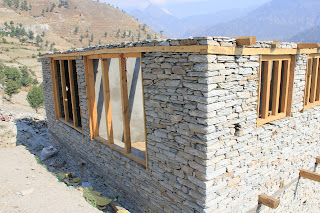
No garbage services either and so the garbage is burned or dumped over the hill, with animal and some human waste as well. There is not very much water. The river is way down in the valley bottom. Some people have chickens, goats, cows and horses and they grow barley, millet, corn and potatoes primarily and other vegetables too. The main street through town, the bazaar, currently has a road-building crew. The men chop the rock out of the mountain by hand, carry it on the horses and lay it in tight rows. It is a very beautiful road. The houses are very well built out of stone, excellent craftmanship! Did I mention it is very dry and dusty?
This morning I saw large birds off our deck. Huge birds...we think they are some kind of condor! I am thrilled to have seen them (and also that they were not too close.) ;)
For the rest of the week we will visit a few communities, assess the birth facilities and do many interviews and focus groups with the community members. Hopefully we will even get to see Rara Lake.:)


 May 6, five of us (Krista, Kristi, Cathy, Mickey, and I) traveled by tourist bus from Kathmandu to Pokhara. It was a beautiful drive. The landscape in this part of Nepal was much more fertile and lush than the Karnali region that we took our jeep ride through last week. Kristi kept commenting on how dry it was and I kept saying it looked great. A matter of perspective for sure!

 We were supposed to fly back to Kathmandu yesterday. The thick dust that has made itself semi-permanent in the valley foiled our plan. We were up early and hauled all our luggage through town only to discover through some mix up our vehicle had left. But there was another vehicle for us. Unfortunately it had a very flat tire, but no problem, some men set about to fix it! We were optimistic about the flight because we really need to get back to Kathmandu. Nani has to work and we are meant to help MIDSON get ready for the conference. Finally we found another vehicle and headed off. We were left with all of bags of gear and training supplies on a gravel pile. We decided to read to pass the time. As the heat increased and the dust resisted clearing our hope of leaving dissipated. Now we needed to make another plan. By this point our driver had already filled the vehicle with 6 others who decided they would go by land to Nepalgunj. 7 hrs for one day along the roads I have been describing and then another day where they would be 2 hrs of pavement. I thought that idea sounded wretched. I feel like a milkshake when we travel by vehicle around 1 hr. I cannot imagine what 7-14 would feel like! Anyways, they headed off in the vehicle, which by then we had all noticed had a weak tire – so dangerous. And then we were there on the gravel pile just waiting.
 It gets worse. Once we arrived back to Gamghadi we made preparations to drive to Nepalgunj in the morning if the sky was still filled with dust and smoke. I’ll save the suspense. We drove. Words cannot describe what it is like to crawl along averaging 8kpm for 10.5hrs but that is what we did on our first day to the soundtrack of a squeaking vehicle or looped Nepali music. I think Nepali music has been designed for Nepali roads...this one song we heard dozens of times probably lasts 15min! The road is sometimes pillowing dust, sometimes hard stones and every variety of rut in between. Do you remember the game popcorn on the trampoline as children? That is what it felt like bouncing along trying not to be too stiff or too loose for fear of bouncing off the sides or the roof. Cathy made herself a neck brace out of a towel and it may have saved her. She was even able to sleep for a bit, I have no idea how! We had been told it would take 7 hours to get to Karikot centre, Manmo. Not so, we only stopped for a total of 45min. and it took 10.5hrs. In Manmo we were lucky to find accommodation and fell to sleep after some dal bhat. Nani and I did not sleep so well but Cathy took the right concoction of anti-inflammatory medication and slept well.
 I would say the end of Day 1 was my lowest point of the trip. The stress of bouncing up and down the mountainside and the accompanying body and headache. At one point I laughed to myself because we were down in the valley and it would only be a 500ft. roll off the cliff and I thought “If we went off the road here it might not be so bad.” Better than the thousands of feet we had been in the hour before! The scenery on Day 1 was very beautiful. We left dusty dry Mugu and worked our way up into the forest. The air was cooler, a bit cleaner and there were lots of nice vistas. We also had the comfort of following the beautiful Karnali river. Occasionally I wanted a swim but mostly I just wanted to keep going, to endure the drive as long as I could so that it could be over.
 Day 2 we left around 5:30am. Our driver Ganesh said if we left at 7am we would get there by 3pm. Cathy and I voted to leave earlier since we and especially Nani wanted to make the plane, as Ganesh’s estimate of 2 more hours to Manmo the night before had turned into 5. Thank goodness we did! Although Day 2 was easier driving, bits of pavement with regular rock or mudslide wash outs, it was still very windy, and bumpy and slow going. When we finally reached pavement that was wide enough for 2 vehicles to pass our driver still insisted on driving in the middle of the road, honking frequently around corners (as was done the entire ride) and swerving at the last minute around the oncoming jeep, bus or truck. I have to say his driving expertise is in the very rough rock and dirt roads and not so much the pavement – mind you everyone coming at us was doing the same thing so it seems the custom in that part of Nepal. And although I imagined a smooth, straight 2 lane road from Surkhet to Nepalgunj, it was not the case. The road still was washed out in places. Most of the pavement was one strip down the centre, and it was windy most of the way. 10.5hrs later we were in Nepalgunj. So it took us around 10 hours to drive 254km on day 2. When we reached the flat tarai I counted over 200 people riding bicycles on the road in less than 30min. Bicycle transport is very common here which made me happy.

 I would like to take a step back now and reflect on some details of our trip that I have not mentioned yet. First of all let me introduce you to Ratna and her family. Ratna was our host at Unique Guest House in Mugu. She was so sweet and kind to us. In the morning one of her family members would make their way up 3 ladders with dudh chia (Nepali milk tea) that I would drink in bed, still curled up in my sleeping bag liner. Although I spent each night trying to find the right balance of blankets underneath for softness to ease my bruised hip bones, and on top to prevent chills from the wind slipping through the cracks in our walls, and although we had to climb up and down to the squat toilet and dank shower stall for a cold bath, our hosts were so gracious that I really enjoyed our time there. It felt like camping in a tree house on the wooden top story of our stone house. Whenever we needed water for washing they would carry it to the house by hand. We did our best to use little water because we saw how difficult it was to carry the water to the house and up the 3 stories to the sink on our floor. For breakfast Ratna would make us boiled eggs and takari (potato curry) and fresh roti. For lunch and/or dinner we would have dal bhat and takari or boiled potatoes with chutneys of chilis (spicy) or sesame or pickled herbs. They were all tasty and we know she made them by hand on a large mortar and pestle. I do not mind eating dal bhat and takari and boiled potatoes every day. The food is good and Ratna is good to make clean food because none of us got sick which is a huge relief given the immense difficulty in getting to the bathroom in a quick way. Seeing her in the morning and the evening when we returned from our long hot, dry, dusty days was so nice. I will think of her and her kindness when I think of Mugu.


 Some very engaging female leaders.


 Today we were able to hire a jeep and visit Pinna village to meet with mother's and FCHVs from the district. We set off in the morning - 6 of us - driver made 7 in a 5 passenger jeep. Tightly packed we headed out on the windy, one lane, road. Sometimes the road is thick powdery dust - Jill said icing sugar - and that describes it perfectly! Sometimes there are stones. We wind up and up and up - past the airport and continue on around the corners. On driver is very confident in his jeep driving skills, sometimes he talks on his phone whipping the wheel this way and that with one hand to make the very tight corners. We had been told 30min drive to Pinna. 1hr 15min later we arrived. I personally prefer walking, but we would not have made it to the community and back in one day without the vehicle so we were glad for it!

 On our way home our driver was late, he was leaving Gamghadi when he was supposed to be meeting us. So we decided to walk towards him. This time we were to talk the lower road. We had a nice walk in the valley, meandering by the river. We met a family at a stop along the way. There was a young mother there with a 3 month old baby. She told us that she had her baby at home and breastfed confidently while we were sitting there. I hope that in Nepal's efforts to reduce maternal and neonatal mortality that they don't forget that other things matter too. Respect, autonomy, choice. Our driver finally met us when we had reached a village. And then we discovered that although the lower road doesn't have the up on the side of the mountain fear factor, it has its own challenges. Steep forward pitches and side pitches were very common. And yet we made it back in good condition and lightly powdered. Showers and dinner and bed time for us as all of us except Jill are going to see Rara Lake tomorrow!

 On day 2 we reviewed the key pieces for birth planning preparedness, Helping Babies Breathe (WHO NRP), postnatal care, 8 danger signs of the newborn and care for a septic baby, management for postpartum hemorrhage and respectful maternity care. We had hands on practice today as well and had stations at the end to practice skills from the 2 days. Most people who participated seemed very interested in the training. Many were taking notes during the presentations and all were eager to do the skills practice. I enjoyed doing it. Their feedback was that they appreciated most learning the different positions in labour and delivery, somersault nuchal cord delivery and all the demonstrations and hands on learning experiences. In the future they would like more training on degrees of prolapsed uterus and treatment options as it is a major problem for women here. Afterwards we were able to do 7 more interviews.
 No garbage services either and so the garbage is burned or dumped over the hill, with animal and some human waste as well. There is not very much water. The river is way down in the valley bottom. Some people have chickens, goats, cows and horses and they grow barley, millet, corn and potatoes primarily and other vegetables too. The main street through town, the bazaar, currently has a road-building crew. The men chop the rock out of the mountain by hand, carry it on the horses and lay it in tight rows. It is a very beautiful road. The houses are very well built out of stone, excellent craftmanship! Did I mention it is very dry and dusty?
 Let me take a few steps backwards. Two days ago we arrived in Nepalgunj. There was a hot wind when we arrived. I was happy to get out of the pollution of Kathmandu but my joy was short lived. The night in our hotel proved very difficult as the power was cut out around 2am. It was very very hot and this Canadian was unable to sleep. The heat was suffocating. In my delirium I just kept reminding myself that the AC would come on at some point. And it did at 6am. I decided to skip breakfast because I was feeling unwell. I thought that I was feeling unwell due to the heat and a bad headache but it turn out that my next 24hrs proved to get progressively worse with diarrhea and vomiting. I will spare you the details but I did not keep anything down for over 24hrs. We spent most of the day at the airport waiting for our flight to go. The way our flight works is that the plane lands and takes people to Simikot. It then returns for us to take to Mugu. We arrived around 9am. Around 1pm our plane finally arrived to take us. We loaded up. It is a Twin Otter plane, I am informed it is made in Canada. The seats are canvas. It is very tight. 3 people across. Then we unloaded. Wind is coming from Southeast instead of the North. The pilot says we need to wait for the wind to change. So we wait. I am sleeping in the terminal because I took gravol and have already removed my stomach contents in one way or another. Then we find out the flight will not go. So we head out. Cathy, bless her, advocates that we go to hotel that has 24 hr AC so that I can sleep and recover. Everyone is happy with that. We get to our hotel. It is nice and clean and I get into bed with AC and sleep all afternoon. In the evening I wake up, just to be sick some more. The gravol obviously had worn off. At this point the nurses all congregated to decided what to do. Pema and Nani thought I should eat. Jill and Cathy could tell there was no way I could keep anything down. So instead I sipped electrolyte beverage very slowly. Eventually I took Cipro and managed to keep it down. Cipro saved me. I was able to keep some breakfast down this am.
 First night arrival in Nepalgunj


 Nani and Pema on the bridge!


